
CNC spindle repair and rebuild
A complete CNC spindle rebuild means full teardown, inspection of every component against the original print, new bearings, taper and shaft grinding where needed, a drawbar rebuild with pull-force testing, and dynamic balancing before closed-loop run-off. It typically costs a fraction of a replacement spindle and avoids OEM lead times.
What a complete spindle rebuild includes
A rebuild is not a bearing swap. The spindle comes apart completely, and every component is measured against the original manufacturer's specification rather than against whatever condition it arrived in. That distinction is the whole difference between a spindle that runs for years and one that comes back in six months.
Bearings are replaced as a matched set with the correct preload for the duty the spindle actually sees. The taper is inspected and reground when contact geometry has degraded. The shaft is checked for straightness and journal condition. The drawbar is rebuilt and its pull force verified against spec.
The assembled spindle is dynamically balanced and run through a closed-loop test cycle at rated speed before it ships. You get the test data with the unit.
How do you know your spindle is failing?
Spindles almost never fail without warning. They give six signals, and they usually appear in roughly this order. Catching one early is the difference between a scheduled rebuild and an unplanned line stop.
Noise that changes with speed
A growl or whine that tracks RPM almost always points at the bearings. It rarely improves on its own, and running through it drives debris further into the raceways.
Rising vibration or a degrading surface finish
Chatter marks and finish problems usually mean bearing preload has relaxed or the shaft has lost true.
Thermal growth and temperature drift
A spindle running hotter than its normal operating band is being asked to overcome friction it should not have. Heat accelerates every other failure mode.
Drawbar pull force below spec
Weak clamping lets the toolholder move under load. It reads as chatter and taper wear, but the root cause is the drawbar stack.
Runout drift at the taper
Runout climbing past its original tolerance means bearing wear, taper damage, or both. Measure it against the machine build sheet, not against last week.
Toolholders fretting or sticking
Marking on the taper face is the spindle telling you the contact geometry is no longer correct. Left alone it damages every holder that goes in it.
Spindle types we service
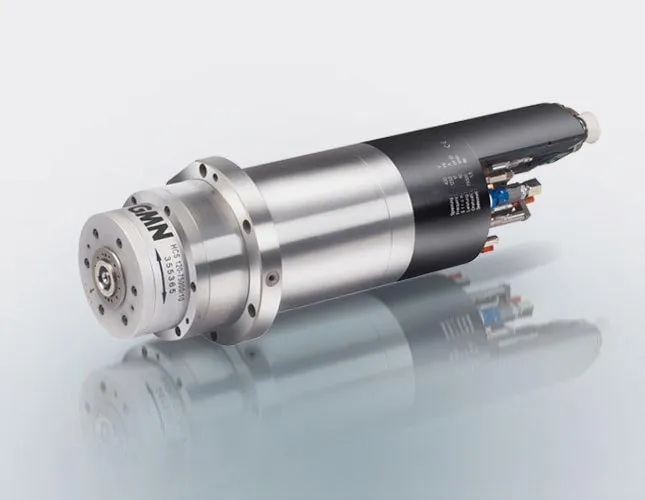
Each drive type fails differently, which is why placement matters. A shop that rebuilds motorized spindles all day is not automatically the right shop for a gear-driven head. A motorized unit like the one pictured puts the rotor inside the spindle, so an electrical fault arrives looking like a mechanical one — and the shop that takes it has to be equipped to tell the two apart before it quotes you.
Belt-driven
Simple and serviceable, but belt tension pulls the front bearings out of their intended load path. Bearing wear tends to be asymmetric and shows up as finish problems long before noise.
Direct-drive
A coupled motor removes belt side-load, so failures concentrate in the bearing pack and the coupling itself. Alignment during reassembly is what determines how long the rebuild lasts.
Motorized
The rotor lives inside the spindle, so heat and electrical faults become mechanical problems. These need both a mechanical rebuild and electrical testing — rotor, stator, and feedback together.
Gear-driven
High torque at low speed, with a gear train that adds its own wear surfaces. Backlash and gear condition get inspected alongside the bearings, or the rebuild only solves half the problem.
A network with names in it
"We know a guy" is worth nothing to a plant manager at 2am. What is worth something is that the shop your spindle lands in has rebuilt your make before, and can prove the rebuild after — and that somebody is accountable for getting it there and back.
Superior Spindle Services in Taylor, Michigan is one of those shops. They are factory trained on Kessler spindles and they run a Kessler Smart Test Stand — which is why every Kessler that comes through DDP goes there and comes back with its run-off data attached.
Your spindle may not be a Kessler. The point is that placement is a decision made on the make, the failure, and who has actually fixed it before — not on whoever has bench space this week.
Repair or replace?
A rebuild is usually the right call. It costs a fraction of a new unit and it does not put you at the mercy of OEM lead times, which on some makes run to months. The spindle you already own was built for your machine, and restoring it to print returns the accuracy you bought.
Replacement makes more sense in a narrow set of cases: a housing that is cracked or has lost bore geometry, a rotor failure on a motorized spindle where a replacement core is not available, or a machine already scheduled for retirement where the rebuild would outlive the equipment.
We will tell you which one you are looking at after the inspection, and we will tell you when the answer is "replace" even though there is less work in it for us. That call is worth more to both of us than one job.
What you get back
Every spindle returns with a documented inspection and test report: what was found on teardown, what was replaced, the measurements taken, and the run-off data. Photographs of the failed components come with it.
That paperwork is not a formality. It goes in your maintenance file. We document and track all spindle rebuilds.
How long does a spindle rebuild take?
A written quote and failure analysis comes back within 1-3 business days of the spindle reaching the facility. Standard repair is 10-14 business days from your approval. If the machine is down, the spindle can be quoted the same day it arrives and returned in 1-3 days.
| Stage | Turnaround |
|---|---|
| Written quote and failure analysis From receipt of the spindle at the facility. | 1-3 business days |
| Standard repair From your approval of the quote. | 10-14 business days |
| Emergency quote The day the spindle is received. | Same day |
| Emergency repair From approval. Weekday overtime and weekend service on request. | 1-3 days |
Standard lead times extend where parts are not readily available or the teardown finds severe damage — you hear that before the clock starts, not after. Emergency service depends on facility availability and cannot be offered on every make and model.
You get a real date before you ship anything — not an estimate that slips.
What does a spindle rebuild cost?
We do not publish a price, and we would rather explain why than quote a range that turns out to be wrong for your spindle. A cartridge off a small mill and a motorized head out of a five-axis are the same job description and nowhere near the same job. What moves the cost is the bearing arrangement, whether the taper and shaft need grinding, whether the drawbar stack is serviceable, and — most of all — what the teardown finds.
What we can tell you before anything is on a bench: a rebuild almost always lands at a fraction of a replacement spindle, and it does not carry the OEM lead time. The teardown quote is written, itemized, and waits for your review and approval.
Call with the make, model, and what it is doing and you will get a realistic bracket on the phone from someone who has priced this failure before.
Spindle capabilities at a glance
- Complete teardown and inspection
- Bearing replacement
- Taper and shaft grinding
- Drawbar rebuild and pull-force testing
- Dynamic balancing
- Closed-loop testing
- Belt-driven
- Direct-drive
- Motorized
- Gear-driven
Mazak · Kessler · Okuma · Weiss · DMG Mori · Fischer · Mag · Bryant · OKK · Setco · NTC · GMN — and many more
Placed with ISO 9001:2015 certified facilities.
Downtime doesn't wait for business hours.
Send the make, model, and what it's doing — or call the emergency line and talk it through. We'll tell you whether it's a rebuild, a replacement, or something you can run until the next shutdown.